Introduction
A decade ago, businesses could post regularly on Facebook, Instagram, or Twitter and reach a large percentage of their followers without spending a dollar on advertising. Those days are largely gone.
Today, social media platforms are more crowded than ever. Millions of businesses, creators, and brands compete for attention every second. While organic content still plays an important role, paid social media advertising has become one of the most effective ways to reach targeted audiences, generate leads, drive website traffic, and increase sales.
Whether you’re a small business owner, an e-commerce seller, a startup founder, a content creator, or a marketing professional, understanding how social media ads work is no longer optional. It’s a critical skill for growth.
What makes social media advertising unique is its ability to reach the right person at the right time with remarkable precision. Instead of showing advertisements to a broad audience and hoping for results, businesses can target users based on age, interests, behaviors, locations, purchase intent, and dozens of other factors.
This guide explores everything you need to know about social media ads in 2026, from understanding the basics to building advanced advertising strategies that deliver measurable results.
What Are Social Media Ads?
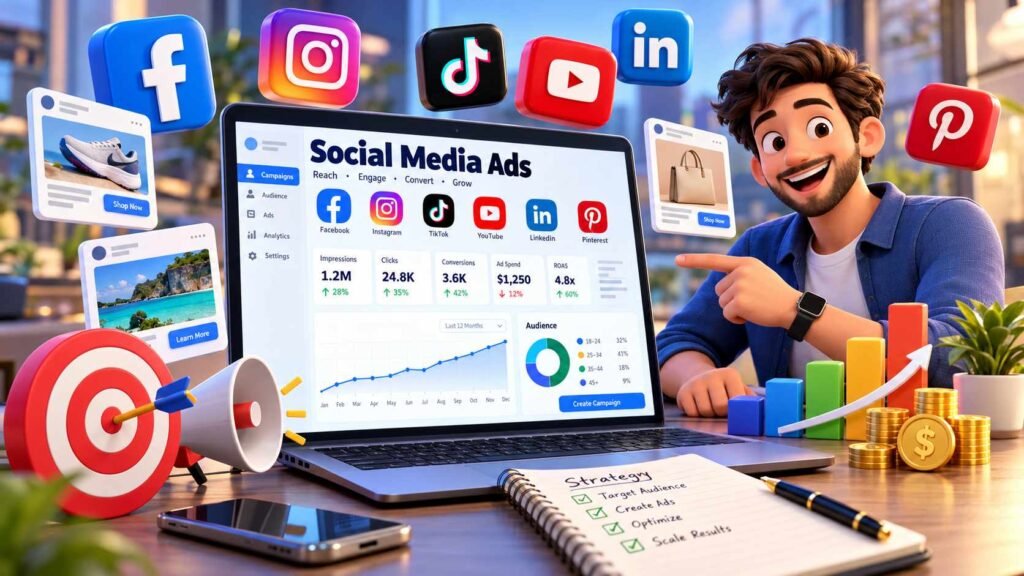
Social media ads are paid promotional messages that appear across social networking platforms such as Facebook, Instagram, TikTok, YouTube, LinkedIn, Pinterest, Snapchat, and others.
Unlike organic posts, which rely on algorithms and follower engagement for visibility, social media ads use advertising budgets to place content directly in front of targeted audiences.
These advertisements can appear in various formats:
- Image ads
- Video ads
- Carousel ads
- Stories ads
- Reels ads
- Sponsored posts
- Lead generation ads
- Dynamic product ads
- Messenger ads
A local coffee shop promoting a new menu item, an online clothing store advertising seasonal sales, and a software company generating leads for a webinar are all examples of businesses using social media advertising.
The primary advantage is control.
Advertisers can decide:
- Who sees the ad
- Where the ad appears
- How much to spend
- What action users should take
This level of targeting makes social media advertising one of the most measurable and scalable forms of digital marketing available today.
Why Social Media Advertising Matters in 2026
Social media advertising has evolved significantly over the past few years. Platforms are becoming more sophisticated, user behavior continues shifting toward mobile devices, and advertisers now have access to more data-driven tools than ever before.
Consumer Attention Lives on Social Media
Consumers spend a significant portion of their online time on social platforms.
People discover:
- Products
- Brands
- Reviews
- Services
- Educational content
- Entertainment
through social media feeds every day.
For many consumers, social platforms have become search engines.
Instead of searching Google first, users increasingly search TikTok, Instagram, YouTube, Facebook Groups, and Pinterest when looking for recommendations and solutions.
Mobile-First Behavior
Modern consumers interact with content primarily through smartphones.
Social media platforms are designed around mobile experiences, making them ideal environments for advertisers seeking immediate engagement.
Mobile-friendly advertising often produces:
- Higher engagement
- Better conversion rates
- Faster purchasing decisions
Advanced Audience Targeting
Traditional advertising often involves broadcasting a message to a large audience and hoping the right people notice it.
Social media advertising is different.
Businesses can target:
- Specific age groups
- Income levels
- Geographic regions
- Interests
- Online behaviors
- Purchase habits
This precision reduces wasted advertising spend.
Faster Business Growth
Businesses can use social media ads to:
- Increase brand awareness
- Generate leads
- Drive sales
- Promote events
- Grow communities
- Launch products
Even relatively small budgets can produce meaningful results when campaigns are managed effectively.
Better Performance Measurement
One of the biggest advantages of social media advertising is accountability.
Marketers can track:
- Clicks
- Conversions
- Purchases
- Leads
- Revenue
- Engagement
This data-driven environment allows businesses to continuously improve campaign performance.
Social Media Marketing vs Social Media Advertising
Many people use these terms interchangeably, but they are not the same thing.
| Social Media Marketing | Social Media Advertising |
|---|---|
| Primarily organic | Primarily paid |
| Focuses on content creation | Focuses on promotion |
| Builds long-term audience relationships | Generates immediate visibility |
| Relies on follower growth | Relies on advertising budget |
| Often slower results | Often faster results |
| Community-focused | Conversion-focused |
Social Media Marketing
Social media marketing includes:
- Organic posting
- Community engagement
- Brand building
- Content creation
- Customer interaction
Its primary goal is building trust and long-term relationships.
Social Media Advertising
Social media advertising involves paying platforms to distribute content to targeted audiences.
Its primary goals often include:
- Traffic generation
- Lead generation
- Sales
- Brand awareness
- App installs
The strongest marketing strategies combine both approaches.
Organic content builds trust, while paid advertising accelerates growth.
How Social Media Ads Work
To beginners, social media advertising may appear complicated.
In reality, most platforms follow a similar framework.
Campaign Structure
Most advertising systems use three levels:
Campaign Level
At the campaign level, advertisers choose their primary objective.
Examples include:
- Brand awareness
- Website traffic
- Lead generation
- Sales
- App installs
Ad Set Level
This level determines:
- Target audience
- Budget
- Schedule
- Placements
Ad Level
This is where the actual creative content lives.
Examples include:
- Images
- Videos
- Headlines
- Descriptions
- Call-to-action buttons
Advertising Objectives
Objectives tell platforms what outcome you want.
Common objectives include:
Awareness
Designed to introduce your brand to new audiences.
Traffic
Focused on generating website visits.
Engagement
Optimized for likes, comments, shares, and interactions.
Leads
Designed to collect customer information.
Sales
Focused on generating purchases.
Selecting the right objective significantly impacts campaign performance.
Audience Targeting
One reason social media advertising is so powerful is targeting.
Instead of advertising to everyone, businesses can reach specific groups.
Examples include:
- Women aged 25–40
- Fitness enthusiasts
- Small business owners
- Recent online shoppers
- Parents
- Homeowners
The more relevant the audience, the better the campaign typically performs.
Bidding Systems
Most social platforms use auction-based advertising systems.
Advertisers compete for ad placements.
Winning doesn’t always depend on spending the most money.
Platforms also evaluate:
- Ad quality
- Relevance
- Expected engagement
- User experience
This helps ensure users see valuable advertisements rather than simply the highest-paying ones.
Optimization
Advertising platforms constantly analyze campaign performance.
Algorithms evaluate:
- Click-through rates
- Engagement
- Conversion rates
- Audience response
Campaigns are then adjusted automatically to improve performance.
Conversion Tracking
Tracking allows advertisers to measure results.
Businesses can track:
- Purchases
- Leads
- Signups
- Downloads
- Phone calls
Without proper tracking, campaign success becomes difficult to evaluate.
Types of Social Media Ads
Different advertising formats serve different goals.
Choosing the right format can significantly impact results.
Image Ads
Image ads are among the simplest forms of social media advertising.
They typically include:
- Single image
- Headline
- Description
- Call-to-action
Advantages
- Easy to create
- Cost-effective
- Fast deployment
Disadvantages
- Limited storytelling
- Lower engagement than video
Best Use Cases
- Product promotions
- Announcements
- Brand awareness
Video Ads
Video advertising continues to dominate social platforms.
Videos can:
- Demonstrate products
- Tell stories
- Educate audiences
- Showcase customer experiences
Advantages
- High engagement
- Strong storytelling
- Better retention
Disadvantages
- Higher production requirements
- More expensive to create
Best Use Cases
- Product demonstrations
- Tutorials
- Brand storytelling
Carousel Ads
Carousel ads allow multiple images or videos within a single advertisement.
Users can swipe through content.
Advantages
- Showcase multiple products
- Higher engagement opportunities
- Better storytelling
Best Use Cases
- E-commerce
- Product catalogs
- Feature comparisons
Stories Ads
Stories ads appear between user-generated stories.
They occupy the full mobile screen.
Advantages
- Immersive experience
- High visibility
- Strong mobile performance
Best Use Cases
- Promotions
- Product launches
- Limited-time offers
Reels Ads
Short-form video advertising continues gaining popularity.
Reels ads blend naturally into user feeds.
Advantages
- Strong reach potential
- High engagement
- Native user experience
Best Use Cases
- Brand awareness
- Product demonstrations
- Creator collaborations
Collection Ads
Collection ads combine product catalogs with visual storytelling.
These ads allow users to browse products without leaving the platform.
Advantages
- Improved shopping experiences
- Higher product discovery
Best Use Cases
- Online stores
- Retail brands
- Fashion businesses
Lead Generation Ads
Lead ads help businesses collect customer information directly within the platform.
Advantages
- Lower friction
- Faster lead collection
- Improved conversion rates
Best Use Cases
- Service businesses
- Webinars
- Consultations
- B2B marketing
Messenger Ads
Messenger ads encourage direct conversations between businesses and potential customers.
Advantages
- Personalized communication
- Higher engagement
Best Use Cases
- Customer support
- Appointment booking
- Sales conversations
Dynamic Product Ads
Dynamic ads automatically show users products they have previously viewed or expressed interest in.
Advantages
- Highly relevant
- Strong conversion rates
Best Use Cases
- E-commerce
- Retargeting campaigns
Audience Targeting Explained
One of the biggest reasons social media advertising works so well is audience targeting.
The ability to show advertisements to highly relevant users dramatically improves efficiency.
Demographic Targeting
Advertisers can target based on:
- Age
- Gender
- Education
- Relationship status
- Occupation
Example:
A university may target high school graduates aged 17–21.
Interest Targeting
Platforms analyze user interests based on behavior.
Examples:
- Fitness
- Travel
- Technology
- Fashion
- Sports
A fitness apparel brand might target people interested in gym workouts and healthy living.
Behavioral Targeting
Behavioral targeting focuses on user actions.
Examples include:
- Online shoppers
- Frequent travelers
- Mobile device users
- Recent buyers
This targeting often produces strong conversion results because it focuses on demonstrated behavior.
Geographic Targeting
Advertisers can target users by:
- Country
- State
- City
- ZIP code
- Radius around a location
Local businesses rely heavily on geographic targeting.
Lookalike Audiences
Lookalike audiences help businesses find new users who resemble existing customers.
Platforms analyze customer characteristics and identify similar users.
This often becomes one of the most profitable targeting methods.
Retargeting Audiences
Retargeting focuses on people who have already interacted with a business.
Examples include:
- Website visitors
- Cart abandoners
- Video viewers
- Previous customers
Retargeting campaigns often generate some of the highest conversion rates in digital advertising.
By targeting users who already know the brand, businesses can significantly improve advertising efficiency.
Best Social Media Advertising Platforms
Not every platform is suitable for every business. The best choice depends on your audience, goals, budget, and type of product or service.
Platform Comparison Table
| Platform | Best Audience | Best Ad Types | Strengths | Weaknesses |
|---|---|---|---|---|
| Facebook Ads | Broad consumer audience | Image, Video, Carousel, Lead Ads | Advanced targeting, huge user base | Competitive market |
| Instagram Ads | Millennials and Gen Z | Reels, Stories, Video Ads | High engagement, visual content | Can be expensive in some niches |
| TikTok Ads | Younger audiences | Short-form video ads | Viral potential | Requires creative content |
| YouTube Ads | All age groups | Video ads | Massive reach, strong intent | Video production required |
| LinkedIn Ads | Professionals and B2B | Sponsored posts, Lead Ads | Excellent B2B targeting | Higher advertising costs |
| Pinterest Ads | Shoppers and planners | Image and shopping ads | Strong purchase intent | Smaller audience size |
Facebook Ads
Facebook remains one of the most powerful advertising platforms.
Best For
- Local businesses
- E-commerce stores
- Service providers
- Lead generation
Strengths
- Advanced audience targeting
- Large user base
- Multiple ad formats
- Strong retargeting capabilities
Weaknesses
- Increasing competition
- Rising ad costs in some industries
Instagram Ads
Instagram is ideal for visually appealing products and brands.
Best For
- Fashion brands
- Beauty products
- Travel businesses
- Influencers
Top Ad Formats
- Reels Ads
- Stories Ads
- Carousel Ads
- Collection Ads
TikTok Ads
TikTok has changed how brands approach social media advertising.
Best For
- Gen Z audiences
- Viral campaigns
- Product launches
- Brand awareness
Success Tip
Focus on authentic content rather than highly polished advertisements.
YouTube Ads
YouTube remains one of the strongest platforms for long-form and educational content.
Best For
- Tutorials
- Product demonstrations
- Educational brands
- Software companies
LinkedIn Ads
LinkedIn is the leader in B2B advertising.
Best For
- SaaS companies
- Consultants
- Agencies
- Professional services
Pinterest Ads
Pinterest users often have strong buying intent.
Best For
- Home décor
- DIY
- Fashion
- Weddings
- Lifestyle brands
How Much Do Social Media Ads Cost?
One of the most common questions businesses ask is:
“How much should I spend?”
The answer depends on:
- Industry
- Audience
- Competition
- Campaign objective
- Platform
Common Pricing Models
CPC (Cost Per Click)
You pay when someone clicks your ad.
Example:
- Budget: $100
- CPC: $1
Result:
100 clicks.
CPM (Cost Per Thousand Impressions)
You pay for exposure.
Example:
- CPM: $10
Result:
10,000 impressions for $100.
CPA (Cost Per Acquisition)
You pay based on completed actions.
Examples:
- Purchases
- Leads
- Signups
Budget Planning Example
| Business Type | Suggested Monthly Budget |
|---|---|
| Local Business | $300–$1,000 |
| Small E-commerce Store | $500–$3,000 |
| Growing Startup | $2,000–$10,000 |
| Established Brand | $10,000+ |
Industry Variations
Some industries pay significantly more.
Higher-cost niches:
- Legal services
- Insurance
- Finance
- Real estate
- Software
Lower-cost niches often include:
- Local services
- Hobby products
- Community organizations
How to Create Your First Social Media Ad Campaign
Many beginners overcomplicate advertising.
Start simple.
Step 1: Define Your Goal
Choose one objective.
Examples:
- Traffic
- Leads
- Sales
- Brand awareness
Step 2: Identify Your Audience
Define:
- Age
- Location
- Interests
- Behaviors
Step 3: Create the Advertisement
Develop:
- Strong headline
- High-quality image or video
- Clear call-to-action
Step 4: Set Your Budget
Start small.
Many successful campaigns begin with modest testing budgets.
Step 5: Launch and Monitor
Track performance daily.
Step 6: Optimize
Improve:
- Targeting
- Creative
- Messaging
- Landing pages
Advertising is an ongoing process rather than a one-time activity.
Social Media Ad Metrics Explained
Understanding metrics is critical for improving performance.
CTR (Click-Through Rate)
Measures how many people clicked your ad.
Formula:
CTR = Clicks ÷ Impressions × 100
Example:
100 clicks from 10,000 impressions.
CTR = 1%
CPC (Cost Per Click)
Formula:
CPC = Total Spend ÷ Clicks
Example:
$200 spent for 400 clicks.
CPC = $0.50
CPM (Cost Per Thousand Impressions)
Formula:
CPM = Cost ÷ Impressions × 1,000
CPA (Cost Per Acquisition)
Formula:
CPA = Total Spend ÷ Conversions
Example:
$500 spent for 25 sales.
CPA = $20
Conversion Rate
Formula:
Conversions ÷ Clicks × 100
ROAS (Return on Ad Spend)
Formula:
Revenue ÷ Ad Spend
Example:
$5,000 revenue from $1,000 ad spend.
ROAS = 5x
Customer Acquisition Cost (CAC)
Formula:
Marketing Cost ÷ New Customers
Tracking these metrics helps businesses make informed decisions.
Best Practices for Social Media Advertising
The most successful advertisers consistently follow proven principles.
20 Actionable Tips
- Start with clear objectives.
- Know your audience.
- Use high-quality visuals.
- Write compelling headlines.
- Focus on benefits, not features.
- Test multiple creatives.
- Optimize for mobile devices.
- Use strong calls-to-action.
- Monitor performance regularly.
- Retarget website visitors.
- Create audience segments.
- Use video whenever possible.
- Refresh ads frequently.
- Match ad messaging with landing pages.
- Track conversions accurately.
- Use lookalike audiences.
- Control frequency levels.
- Scale winning campaigns gradually.
- Review analytics weekly.
- Focus on long-term customer value.
Common Social Media Ad Mistakes
Targeting Too Broadly
Trying to reach everyone often leads to poor results.
Ignoring Mobile Users
Most users interact through mobile devices.
Weak Creative
Poor visuals reduce performance dramatically.
No Conversion Tracking
Without tracking, advertisers cannot measure success.
Scaling Too Quickly
Increasing budgets too aggressively can disrupt campaign performance.
Ignoring Landing Pages
A great ad cannot compensate for a poor website experience.
Advanced Social Media Advertising Strategies
Once the basics are working, advanced strategies can significantly improve results.
Funnel Marketing
Top of Funnel
Focus on awareness.
Middle of Funnel
Focus on engagement.
Bottom of Funnel
Focus on conversions.
This approach aligns advertising with customer behavior.
Retargeting
Retarget users who:
- Visited your website
- Viewed products
- Watched videos
- Added items to cart
Retargeting often produces the highest ROI.
A/B Testing
Test variations of:
- Headlines
- Images
- Videos
- Calls-to-action
Small changes can create large improvements.
Creative Testing
Winning advertisers test creative constantly.
Consumer preferences change over time.
Audience Segmentation
Separate audiences based on:
- Interests
- Behaviors
- Purchase history
This improves personalization.
Conversion Optimization
Improving landing pages can often increase results without increasing ad spend.
AI and Automation in Social Media Ads
Advertising platforms increasingly rely on automation.
Audience Targeting
Systems analyze massive amounts of behavioral data.
Creative Suggestions
Platforms now provide recommendations for improving ad performance.
Bid Optimization
Automated bidding adjusts in real time.
Performance Forecasting
Predictive systems estimate campaign outcomes before significant budget allocation.
Businesses that understand automation can often improve efficiency while reducing manual work.
Real-World Social Media Ad Examples
Example 1: Local Fitness Studio
Goal:
Increase memberships.
Strategy:
- Geographic targeting
- Video ads
- Free trial offer
Result:
Strong lead generation from nearby residents.
Example 2: E-Commerce Fashion Brand
Goal:
Increase sales.
Strategy:
- Dynamic product ads
- Retargeting
- Carousel ads
Result:
Higher conversion rates from returning visitors.
Example 3: B2B Software Company
Goal:
Generate leads.
Strategy:
- LinkedIn Ads
- Lead forms
- Educational content
Result:
Qualified leads and lower acquisition costs.
Future of Social Media Advertising
Several trends are shaping the future.
More Automation
Advertising systems will continue handling optimization automatically.
Increased Personalization
Users will receive more relevant advertisements.
Video Dominance
Short-form and video-first advertising will continue expanding.
Creator Partnerships
Brands will increasingly work with creators and influencers.
Commerce Integration
Shopping experiences will become more seamless within social platforms.
Privacy-Focused Advertising
Advertisers will rely more on first-party data and customer relationships.
Frequently Asked Questions
What are social media ads?
Social media ads are paid advertisements displayed on platforms such as Facebook, Instagram, TikTok, LinkedIn, YouTube, and Pinterest.
Which social media platform is best for advertising?
The best platform depends on your audience and goals. Facebook and Instagram are popular for consumer brands, while LinkedIn is strong for B2B marketing.
How much should beginners spend on social media ads?
Many beginners start with $5–$20 per day to test campaigns and gather performance data.
What is CPC?
CPC stands for Cost Per Click, which measures how much you pay when someone clicks your advertisement.
What is ROAS?
ROAS means Return on Ad Spend and measures revenue generated compared to advertising costs.
Are social media ads worth it?
When campaigns are properly managed and targeted, social media advertising can deliver significant returns.
What is retargeting?
Retargeting shows ads to users who previously interacted with your website or content.
Why are video ads effective?
Video captures attention, explains products clearly, and often generates higher engagement than static images.
How often should ads be updated?
Many advertisers refresh creatives every few weeks to prevent audience fatigue.
What is the biggest mistake beginners make?
Launching campaigns without proper targeting, tracking, or testing.
Conclusion
Social media advertising has become one of the most powerful marketing tools available to businesses, creators, and organizations. Whether your goal is brand awareness, lead generation, e-commerce sales, or community growth, social media ads provide precise targeting, measurable results, and scalable opportunities.
Success comes from understanding your audience, choosing the right platform, creating compelling ads, tracking performance, and continuously optimizing campaigns. The advertisers who consistently test, learn, and improve are often the ones who achieve the strongest long-term results.
As social platforms continue evolving, businesses that invest in strategic social media advertising will remain well-positioned to reach customers, build brand visibility, and drive sustainable growth.



Pingback: How to Change Background Color on Instagram Story (2026)